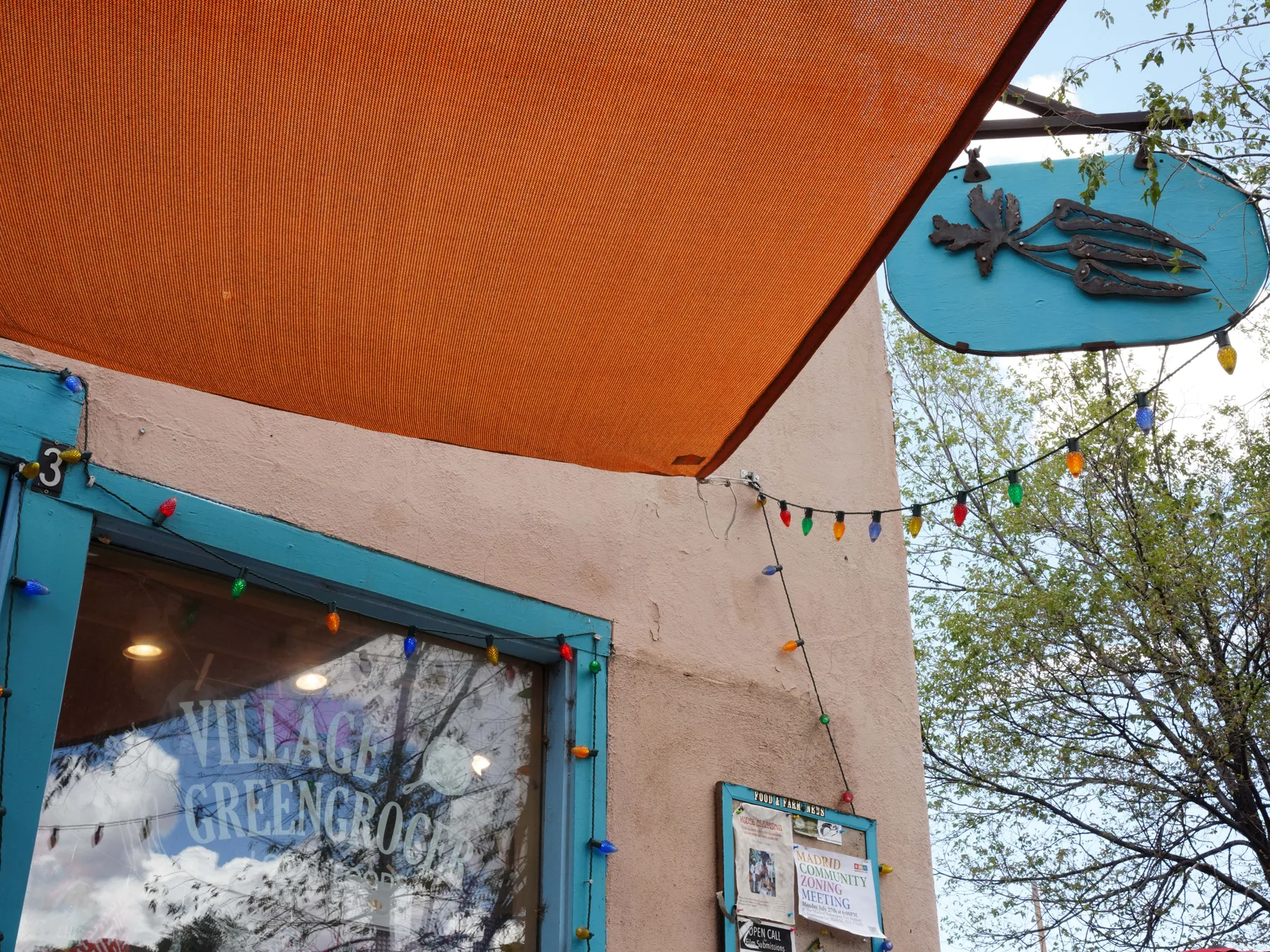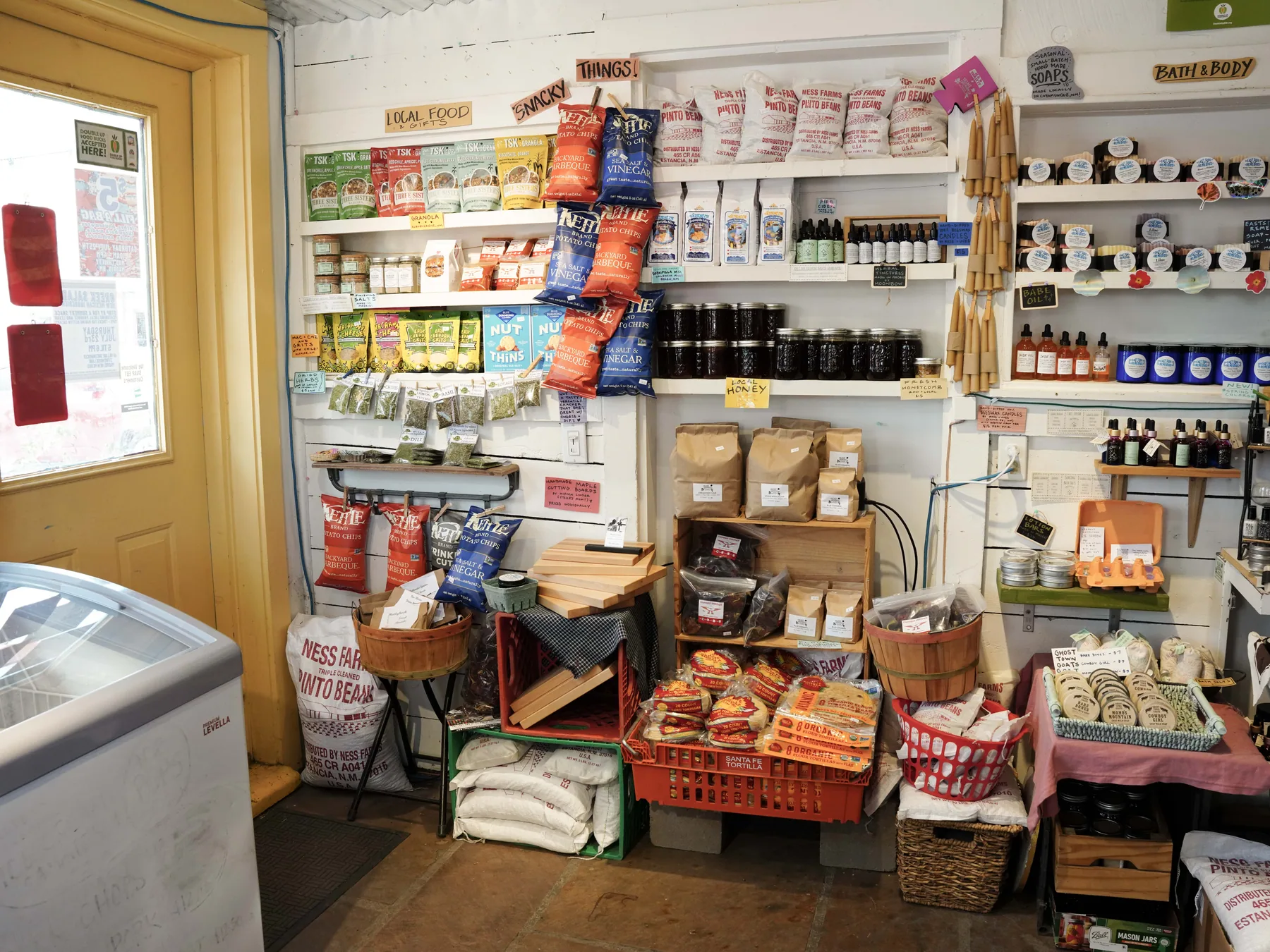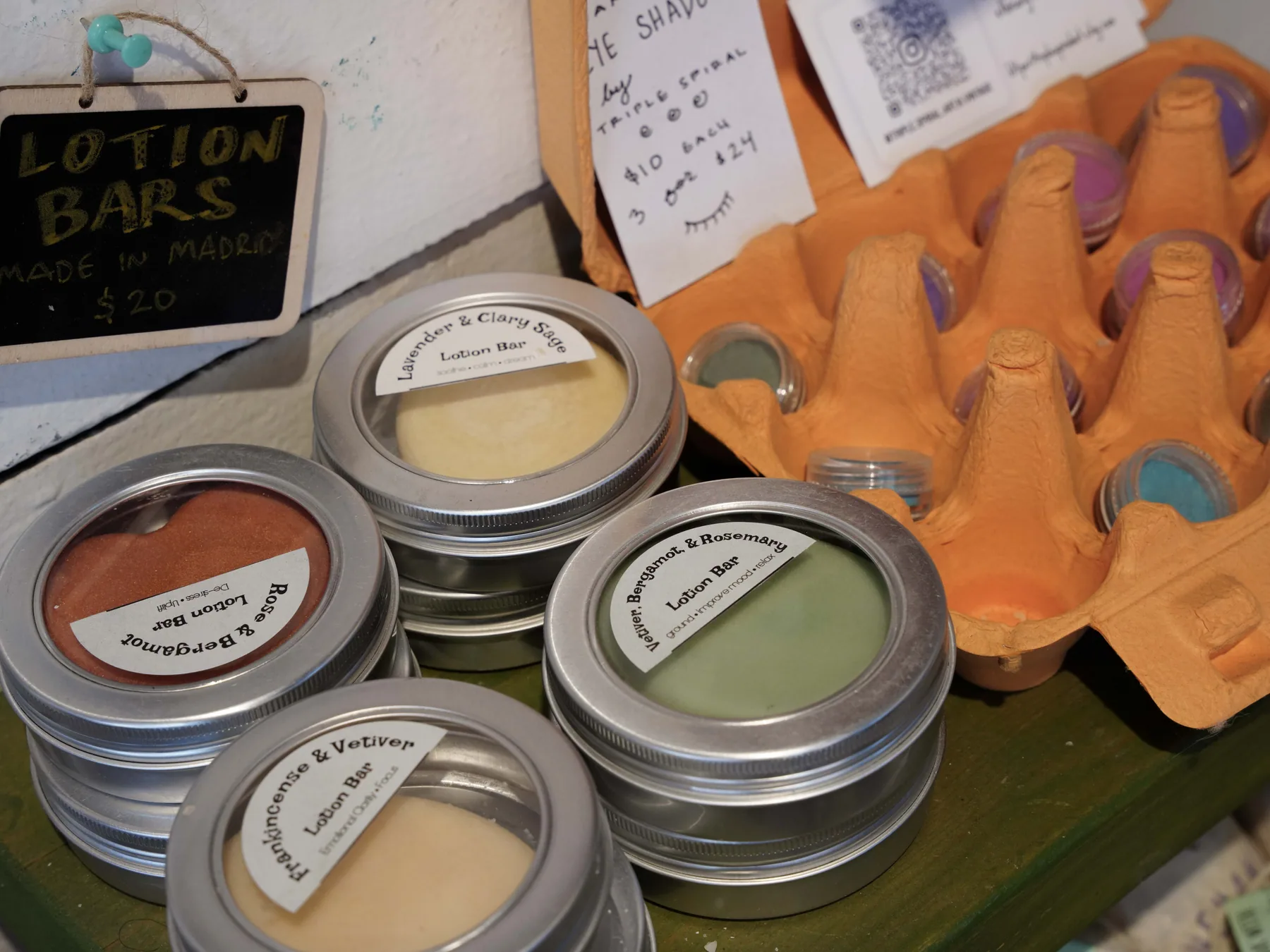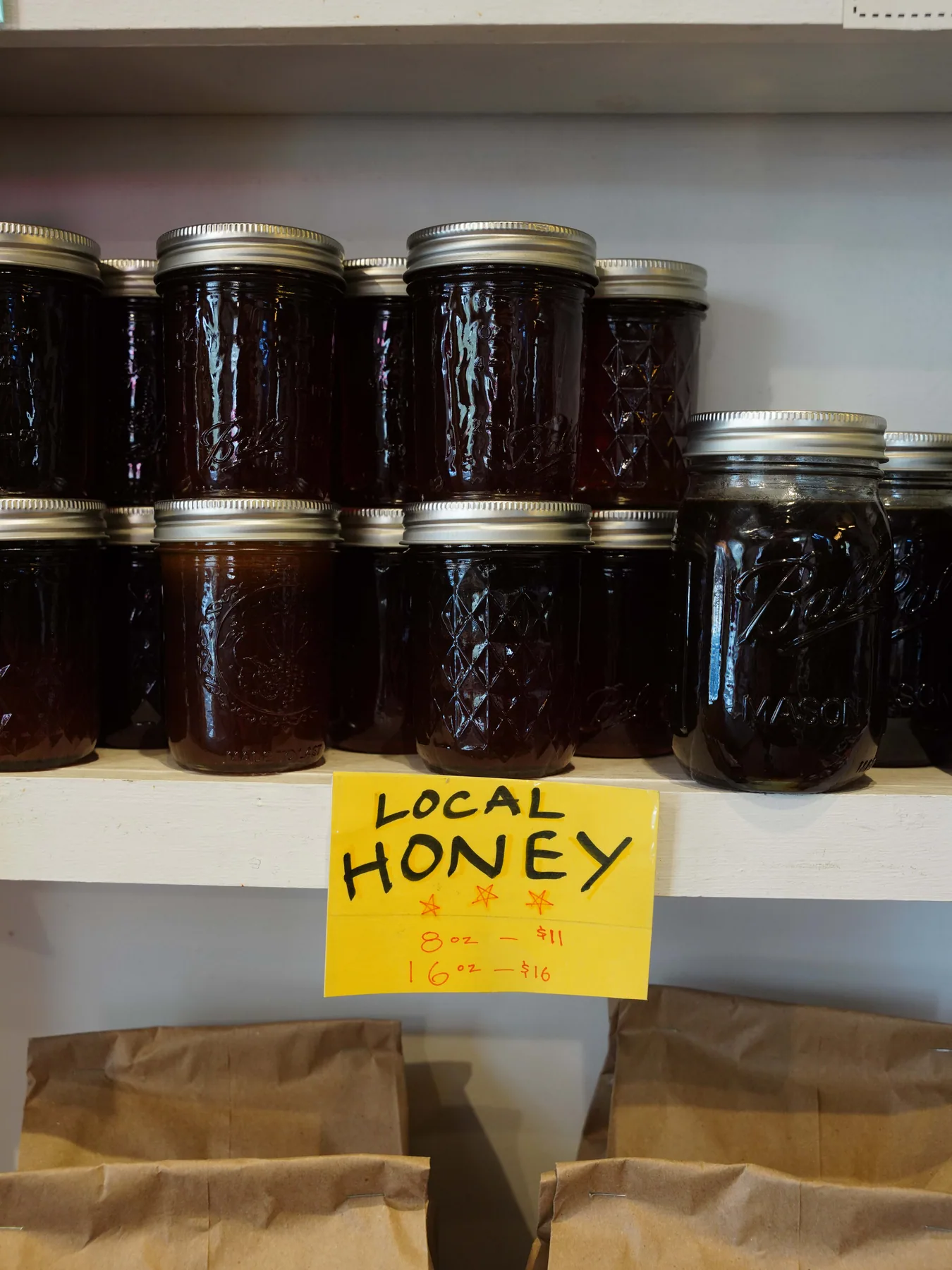
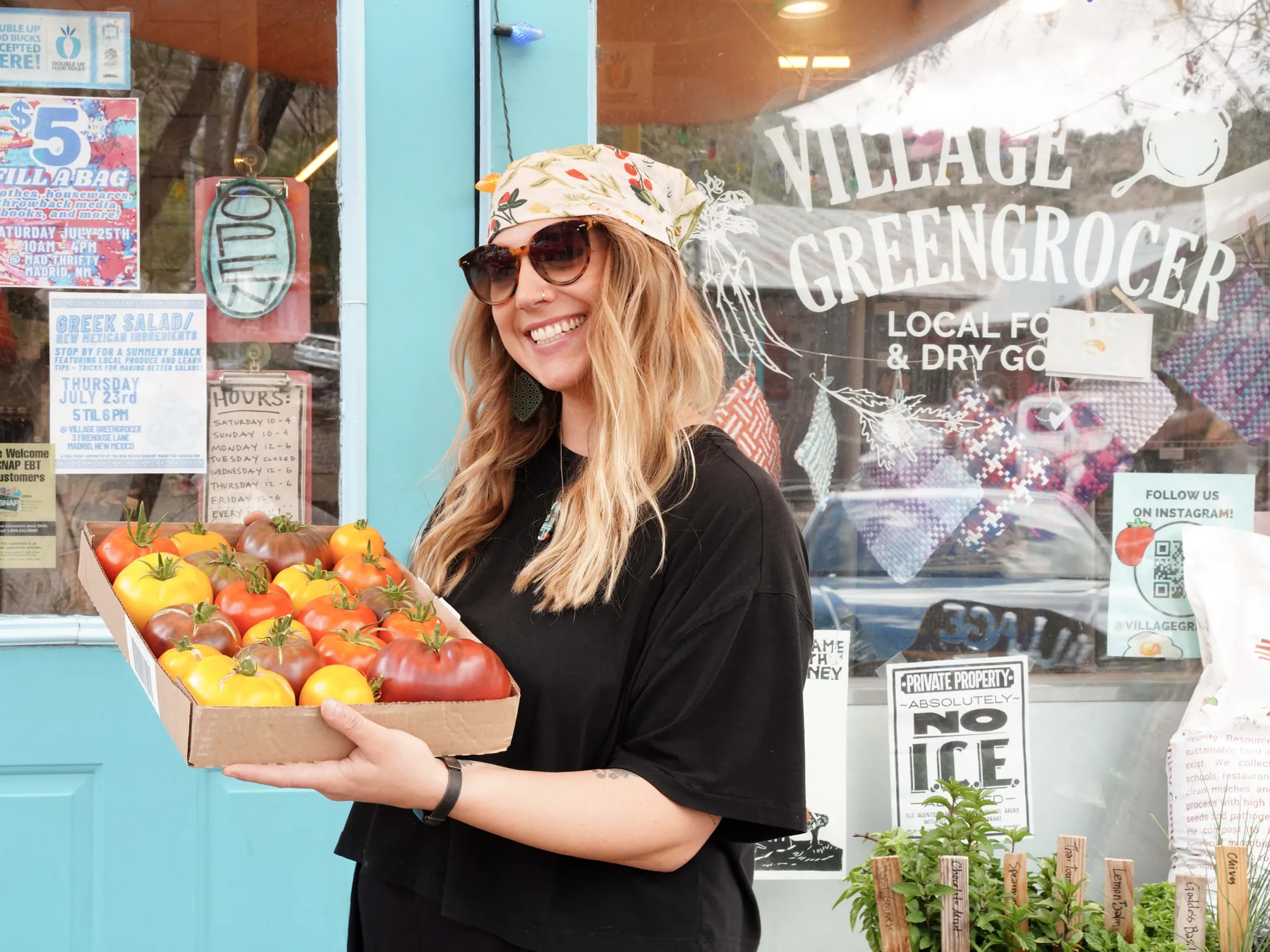
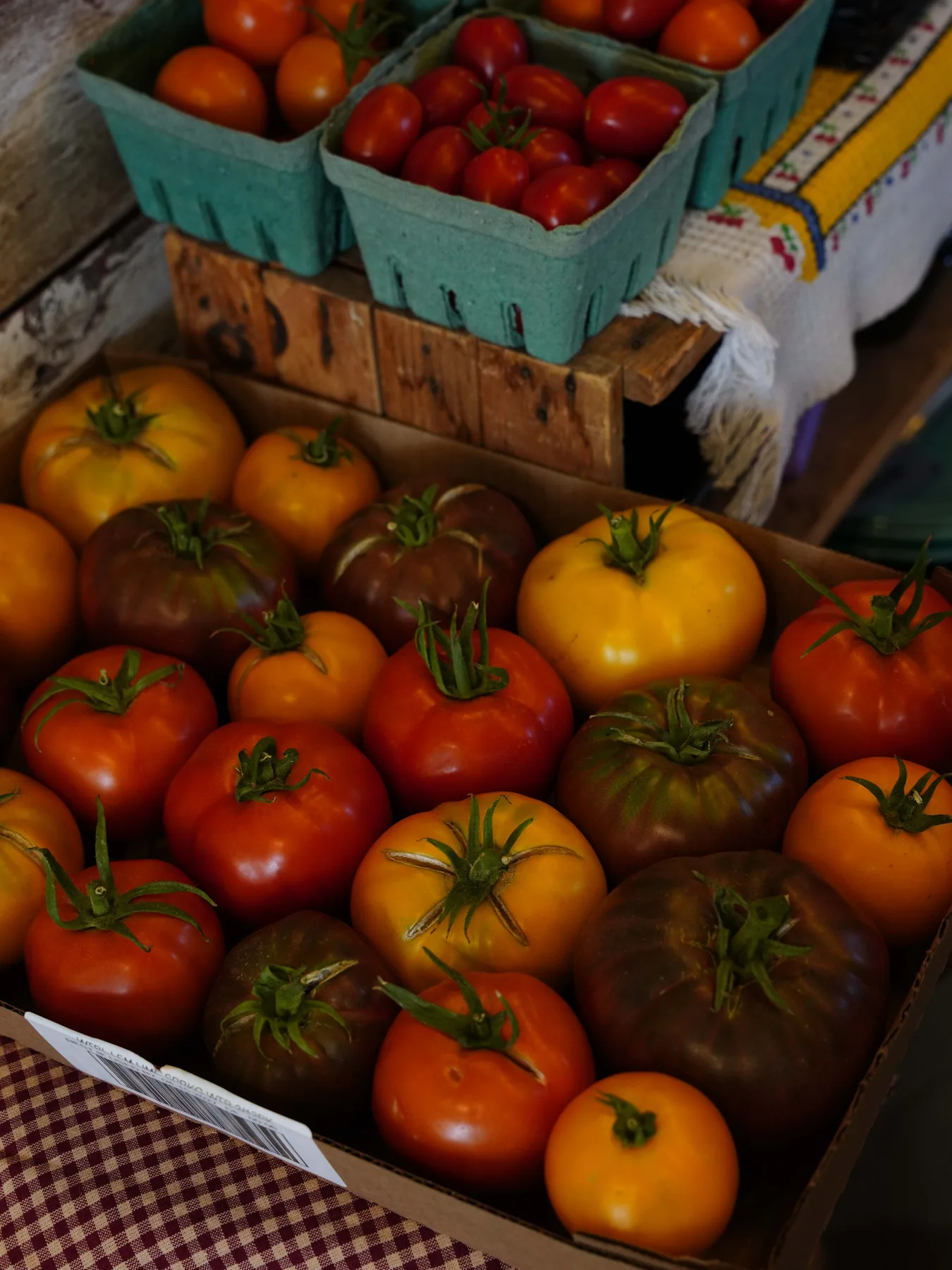
In Madrid, some people come into Village Greengrocer and ask why the potatoes are free. They ask again when they hear the answer. As Stella Byrne and Kate Finio talked about it, I thought about how long it can take to believe somebody really means to give you food.
In 2020, when people were trying to avoid trips to bigger stores, Stella and Kate started selling produce and staples one day a week outdoors. Now there’s a place to sit outside the shop. In a town where your phone may have no signal, you can use the Wi-Fi or tell somebody you’ll meet them at the grocery.
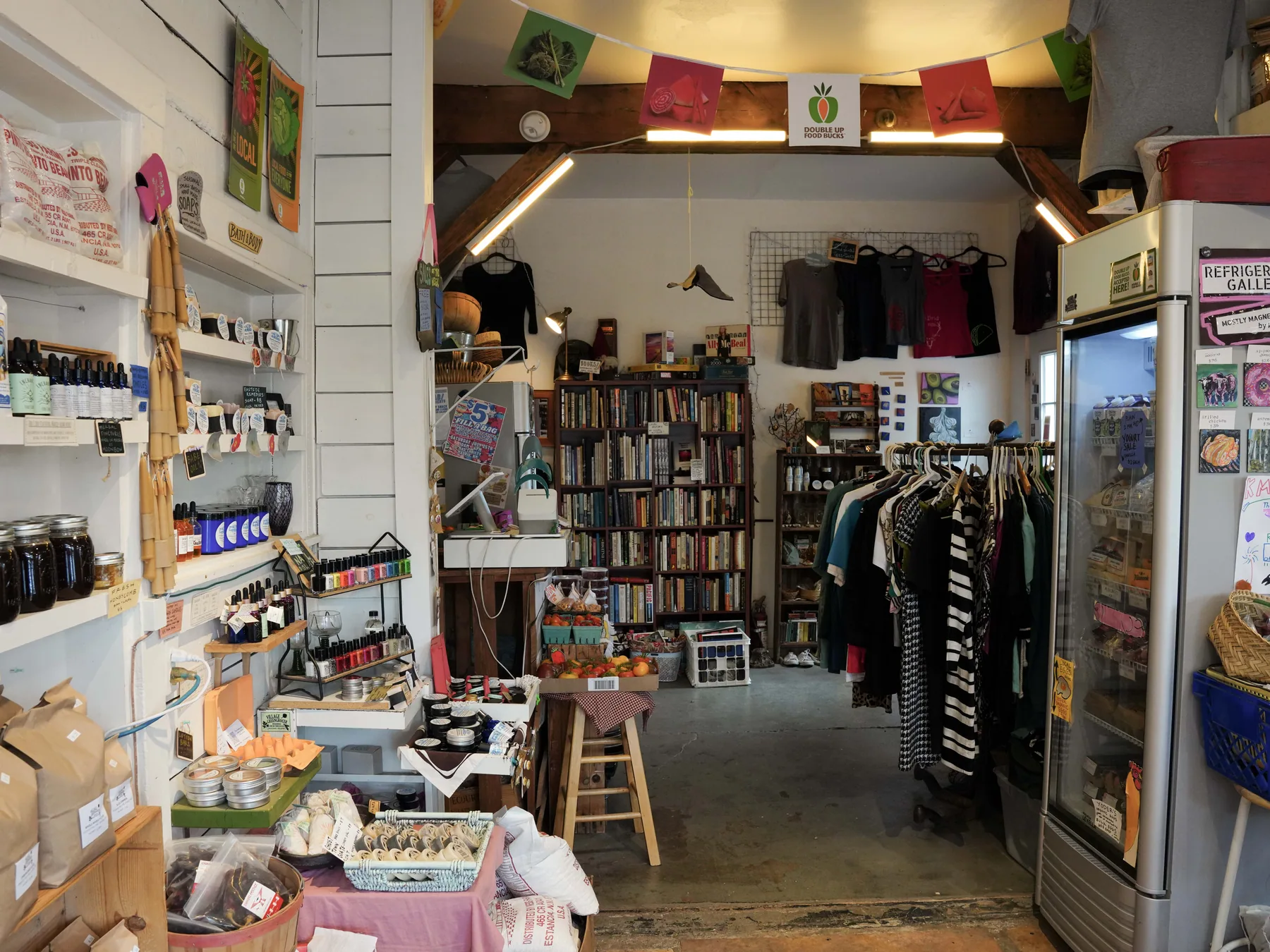
Stella Byrne describes their relationships as “concentric rings.” Close in are producers they deal with directly and neighbors they know by name. They took down a wall between the grocery and Mad Thrifty next door and began sharing space, labor and overhead. The shop underwrites the local radio station, which Stella founded and manages. They also work with the local food program, which offers meals and free food.
“We wouldn’t exist in this way without Mad Thrifty, which is the thrift store next door.”
A small store buys what its growers have. That can mean talking with a customer about preparing something unfamiliar, or asking them to wait for a crop to come in. Stocking the free food and helping someone trust that it really is free take time too. Rent and paid work still have to come out of the business.
“We know so many of our customers personally who are coming into the store. And that is kind of the whole purpose.”
When the conversation turns to what a healthy Madrid would look like, housing and health care come up alongside food. “The size of this town is enough that it feels like you can make a difference,” Kate Finio said.
About the work
- The need
- Fresh produce and staples during the pandemic
- What changed
- The farm stand grew into a permanent shop and gathering space. Sharing resources with Mad Thrifty helped both neighbors use the building.
- What’s still difficult
- The store has to cover costs while keeping food accessible. Stella and Kate’s interview describes the work behind that balance.
Interview
The first farm stand
Tina Trout What needs in your community did you first address with this project, and how has that evolved? Will you start us off, Stella?
Stella Byrne Our inaugural mission was access to fresh produce, but also staple foods, during the pandemic. That was the need at the time, when people were really trying not to go to the grocery store.
We weren’t really intending for that to happen. Even the bulletin board’s very active and has its own little life to it.
The relationships around the store
Tina Trout What relationships absolutely must exist for the success of this operation?
Kate Finio We get some snacks and dairy through La Montañita Co-op. Other than that, we’re working with our beef people, our pork people, the flour mill and the tortilla company. It’s very one-on-one with the producer relationships.
Stella Byrne We wouldn’t exist in this way without Mad Thrifty, the thrift store next door. We knocked down the wall and share some overhead, resources and labor.
Stella Byrne I feel like we’re working our way out in concentric rings.
Kate Finio The neighbor relations. We know so many of our customers personally who are coming into the store.
What was already here
Tina Trout What strengths, resources or forms of local knowledge have made this possible?
Stella Byrne We were already living here. I want to talk about some of the other people and organizations and projects that inform this and make this possible and strong.
Kate Finio Stella and I, and a lot of other people who live in Madrid, are living here because we want to live here. We like the small-town thing. We like the ruralness of it. The store was born because we wanted to make all of that a little bit easier. We were taking advantage of the resources that existed, and we wanted to add to that. The local food outlet wasn’t really here, the fresh produce.
Stella Byrne It feels like a gift and a hard-won thing to live and work in the same community when it’s a small rural community. It’s something neither of us does a hundred percent of the time. I don’t think there’s some moral high ground in that. It feels great, and having this business supports that for us. Hopefully it supports other people in being able to have more of their needs met within their own community.
Staying open
Stella Byrne I’m going to make a sweeping generalization, but small businesses succeed when they have independent capital. That’s not how this business was built or runs. That’s a source of tension.
Stella Byrne There’s also a tension with the model of grants and loans. We’re both pretty critical of the concept of self-sufficiency. We’re into community interdependence. We don’t want to be reliant on unstable funding, and we want the model to support itself. Can grocery do that? That’s the ongoing question.
Stella Byrne What comes out of the tension over the money of it all is thinking about growth in sustainable ways. Obviously, we want to be financially stable in our business and in our lives.
Kate Finio We just celebrated five years in the brick and mortar, which is kind of big.
What Madrid has now
Tina Trout What exists today because of the work that did not exist before?
Kate Finio There’s more food available, but Stella and I both live in Madrid. We both can walk to work. That’s big. There are limited job opportunities out here. We’ve worked at a bunch of them. It’s nice to add something else to that for ourselves. It’s a big something.
Stella Byrne I feel proud of the ways that we’re in relationship, on a material and immaterial level, with our producers. I hope that has made a positive impact on them.
Kate Finio It’s cool to know what else is going on in the area that we might not otherwise have known about. If we knew about it, how do we engage with it? To have a working relationship with other people doing cool stuff and making cool stuff has been fun.
A healthy town
Tina Trout What would make your community more resilient over the next ten years?
Stella Byrne I’m cautious about the word healthy. I want to see our community be really healthy. I mean that people have housing security, access to health care and access to food, and experience stability, security and safety. We’re in such an extreme moment, politically and economically, that it feels pretty far from that vision.
Closing reflection
Tina Trout All is in the small because…
Stella Byrne I’m going to paraphrase Dean Spade, who says our movements are only as strong as our relationships. That’s an important part of the answer for me.
Kate Finio This whole project has helped us reflect on and put into action what we have here, what we already can bring to the table and how we can implement it. If we’re all working together, we can do it. We’re an unincorporated town. I think that’s a big strength. We can create our own reality here. The size of this town is enough that it feels like you can make a difference, as one person, as two people, as a store, as a team.
Stella Byrne I’m really pro reinvent the wheel.
More from Kiara’s visit 8 photographs